Epicraft
- 4.8
- Rating
- 50.00K
- Installs
- Free
- Price
 Analysis by App-foxy
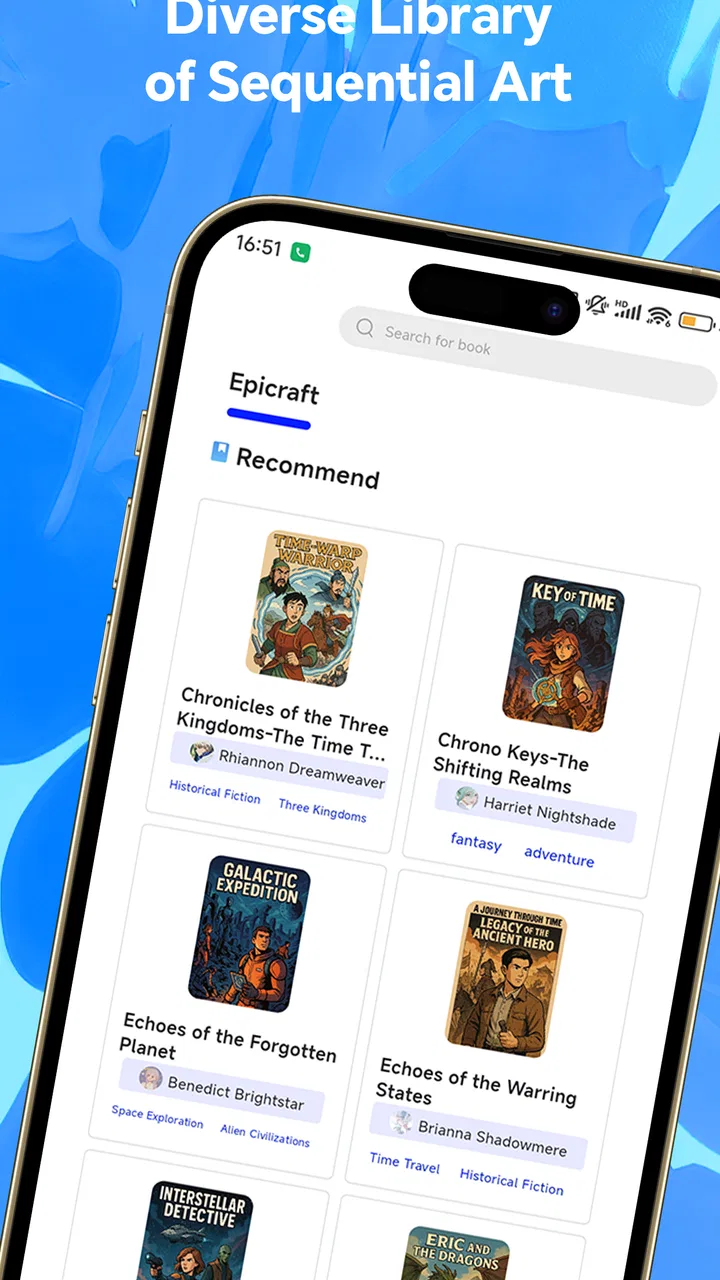
I approached Epicraft as a reading app rather than as a conventional digital library. Its focus is serialized art: stories and visual work released in continuing parts, designed to be followed over time instead of consumed as a single finished book. That distinction matters. If you enjoy checking in on an unfolding story, the format can feel lively and easy to fit around a busy day. If you want a complete novel, a broad reference shelf, or a quiet reading tool with no discovery layer, the experience may feel less suitable.
What I found most interesting is the way the app turns browsing into part of the reading process. You are not simply opening a file you already own. You are looking through a collection, deciding which series deserves your attention, and building a personal rhythm around new installments. That makes it closer to a serialized reading platform than to a standard ebook reader. The developer is pixcho, and the app sits in the Books & Reference category, although its visual storytelling gives it a more entertainment-focused feel than many apps in that section.
The app is free to install and is rated for Everyone, which makes it approachable for households with different readers. It has reached over 50 thousand installs and holds a 4.8 average from around 4.2 thousand ratings, with more than 400 written reviews. Those figures suggest that the basic idea is connecting with its audience, but they do not remove the need to decide whether serialized art matches your own reading habits.
You May Also Like

 Blood Strike: 2.5 Anniversary
Blood Strike’s Loadouts Turn Every Drop Into a Tactical Gamble
A close look at Blood Strike’s custom loadouts: how fast access to signature weapons reshapes its battle royale rhythm, rewards preparation, and narrows the gap between fights.

 Pandora - Music & Podcasts
Pandora’s Music Is Easy to Start, but Harder to Recover
Pandora’s strength is its low-effort path from a seed to a station. Its weak spot is how much confidence it asks you to place in connection, setup, and quiet recovery.

 8 Ball Pool
 Is Built on Rivalries, Rematches, and Routine
A close look at the rivalries, rematches, shared routines, and unanswered safety questions that turn a quick pool match into a persistent mobile community.

 Samsung Music
’s Quiet Strength Is Playing What You Already Own
Its reach comes less from spectacle than from dependable access to a personal library. That simplicity is both the app’s strongest retention engine and its ceiling.

 AccuWeather: Weather Radar
AccuWeather Review: A Quick, Clear Forecast for Everyday Decisions
For everyday plans, the best forecast is the one you can understand quickly. AccuWeather makes rain timing, radar, and local conditions easy to act on, with a few trade-offs.

 Hill Climb Racing
Why Hill Climb Racing Still Turns Crashes Into One More Run
A tiny car, a bumpy hill and one more upgrade: Hill Climb Racing keeps resurfacing because its simple chaos makes every near-miss feel personal.
More From Our News Desk
View All News


How Epicraft feels in everyday use
My first useful test for an app like this is not a long evening session. It is the small gap in an ordinary day: waiting for an appointment, taking a short break, or winding down before sleep. Serialized content works well in those moments because an installment gives the session a natural stopping point. Instead of wondering whether I have enough time to start a full chapter, I can open the app, read a portion, and leave without losing the shape of the story.
That convenience also creates a different kind of commitment. A traditional book lets me move at my own pace through a completed work. A serialized collection encourages me to return, remember where I stopped, and follow several ongoing pieces at once. For some readers, that recurring routine is the main attraction. For others, it can become frustrating when they want immediate closure or prefer to wait until a complete story is available.
The strongest use case is someone who likes visual storytelling but does not want to search across several unrelated services. Epicraft gives that reader a dedicated place to explore serialized art and decide what to follow. It can also suit people who find long-form reading intimidating, because smaller installments make it easier to begin. I would especially recommend trying it if you enjoy discovering lesser-known series through browsing rather than selecting only familiar authors or established titles.
There is a practical trade-off, though. A large collection can make choice harder, not easier. When an app presents many possible series, the real challenge becomes filtering your attention. I found it useful to treat the first session as sampling rather than committing: open several promising works, notice which visual style and pacing hold your interest, and only then decide what deserves regular reading time. That approach prevents a crowded library from turning into a list of unfinished starts.
What the current version tells us
The current release is version 1.0.9, while the app first appeared on April 30, 2025. That combination gives Epicraft the feel of a relatively young product that has already moved beyond its earliest build. I would not read the version number as proof of a complete or mature platform, but it does show that the app has had room to progress since launch.
For existing users, the most sensible expectation is refinement rather than a completely different product. A version in this stage may still be establishing how its collection is organized, how readers discover series, and how smoothly the reading routine works from one session to the next. The important question is not whether the number looks high or low. It is whether the current build makes returning to an unfinished series simple and whether browsing feels more helpful than distracting.
I also prefer to judge a young reading app by its consistency. Visual content can be enjoyable in isolation, but a serialized platform needs a reliable sense of continuity. Readers need to feel that the app supports an ongoing habit, not just a first impression. Epicraft’s current identity is clear enough: it is built around access to a broad body of serialized art rather than around a single book format. The next stage of its development will be especially important for the small details that shape regular use.
One helpful workflow is to separate discovery from reading. I would browse when I have time to compare series, then return later when I want to read without making another decision. This sounds simple, but it changes the app from a place where I endlessly scroll into a place where I maintain a manageable reading queue. It is also a good way to notice whether the app’s organization supports your habits or makes you work too hard to find what you already started.
How it compares with ordinary reading alternatives
Compared with a standard ebook app, Epicraft is more focused on visual serial storytelling and less suited to people who mainly read finished text-based books. A conventional ebook reader usually wins when you want dependable support for books you already have, a familiar page-by-page experience, or a large collection of established written works. Epicraft wins when the appeal lies in discovering an ongoing visual series and reading it in smaller portions.
It also differs from general web browsing. Searching the open web can expose you to an enormous range of creative work, but the experience is often fragmented. You may move between pages, creators, and unrelated sites without a consistent reading routine. A dedicated app can be more comfortable when you want one place for serialized art, even if that focus means the selection is narrower than the entire internet.
There is another comparison with social platforms. Social feeds are excellent for quick visual stimulation, but they are built around constant novelty. Epicraft’s serialized approach is better for following narrative continuity. You are not merely looking at isolated images; you are choosing whether a continuing work deserves your attention. If your priority is conversation, sharing, or fast-moving trends, a social platform may remain more satisfying. If your priority is staying with a visual story, Epicraft has the clearer purpose.
That purpose is also why I would not recommend it automatically to every reader. Someone looking for academic references, news, language-learning material, or a conventional audiobook library should choose a tool designed for those needs. The Books & Reference label describes its broad placement, but the actual experience is much more specific. Its value depends on wanting serialized art, not simply wanting any kind of reading material.
Where the free model helps and where it needs attention
Being free to install lowers the barrier to trying the app. I can explore the concept without paying before knowing whether the format suits me, which is important for a newer service with a specialized focus. The free entry point also makes it easier to recommend Epicraft to a friend: they can test the collection and reading rhythm for themselves instead of making a decision based only on a description.
At the same time, the app includes in-app purchases ranging from $9.99 to $149.99 per item. That is a wide span, and it means I would pay close attention to what an individual purchase unlocks before confirming it. The free installation should be treated as an invitation to explore, not as a promise that every part of the collection is included without charge. For careful users, the best habit is to understand whether a purchase provides lasting access, a specific collection, or another form of expanded use before spending.
This pricing structure creates a clear trade-off. Readers who only want occasional sampling may be perfectly happy staying within the free experience. A dedicated fan who wants broader access may find a purchase worthwhile, but only after identifying a meaningful reason to upgrade. I would avoid buying impulsively just because a series catches my attention in the first few minutes. Read enough to confirm that you like the artwork, pacing, and tone, then decide whether the additional access fits your budget.
For parents, the Everyone rating makes the app easier to consider in a shared-device setting, but an age label should not replace personal judgment. Serialized art can vary in tone and subject even when an app is broadly accessible. I would still look at the individual work before handing the device to a younger reader, particularly if the child is exploring independently. That is not a criticism unique to Epicraft; it is simply sensible when a collection contains many different creative works.
Small habits that make the experience better
My first practical tip is to keep the number of active series low. The temptation in a discovery-heavy app is to start everything that looks interesting. That creates a weak reading experience because each return begins with remembering several plots instead of enjoying one. Choosing a small rotation makes serialized reading feel intentional and helps reveal which works genuinely hold your attention.
My second tip is to use short sessions as a test of pacing. Do not judge a series only by its artwork or opening image. Read enough installments to see whether the story develops at a rhythm you enjoy. Some readers want quick reveals, while others prefer gradual world-building. A collection can contain appealing visuals that do not lead to the kind of narrative momentum you personally want, so sampling over several visits is more informative than making a decision from a single glance.
A third useful insight is to think about when you read, not just what you read. Serialized art suits predictable pockets of time, but it can become a poor choice if you need uninterrupted concentration for a long, complex work. I would use Epicraft for commutes, breaks, and evening decompression, then keep a conventional ebook or print book available for deep reading. The two formats complement each other rather than competing directly.
Finally, I would treat purchases as a commitment to a reading habit. If you open the app only once every few weeks, broad access may not offer much value. If you return regularly and have found several series that you genuinely follow, the calculation changes. This is one of the less obvious decisions with a serialized platform: the quality of the collection matters, but the frequency of your own return matters just as much.
What still feels unfinished
Epicraft’s biggest possible weakness is the natural uncertainty around a young, evolving collection. A serialized platform depends on ongoing reader interest, clear discovery, and a steady reason to come back. If any one of those becomes difficult, the app can feel less useful even when the individual artwork is attractive. I would therefore judge it over repeated sessions rather than relying only on the first browse.
The format itself may also create friction for readers who dislike waiting between installments or who prefer to own a complete work in a familiar file-based library. Epicraft is not the obvious replacement for a personal ebook collection. It is a different reading model, and the difference becomes more noticeable when you want offline-style ownership, a fixed reading order, or a book that can be finished in one continuous stretch.
Another limitation is attention management. A broad catalog is valuable only when I can quickly recognize what fits my taste. If browsing takes longer than reading, the app loses some of its advantage. My workaround is to sample selectively and stop exploring once I have found enough to read. That keeps the discovery side from taking over the experience.
I would also be cautious about assuming that a high average rating means the app will suit every reader. The rating is encouraging, and the volume of feedback gives it more weight than a handful of opinions, but ratings usually reflect overall satisfaction rather than a precise match for your preferred genres, pacing, or reading style. The most honest test remains a short personal trial.
Who should try it now
I think Epicraft is a good fit for readers who enjoy visual narratives, like discovering serialized work, and appreciate a free way to explore before deciding whether to spend. It is particularly appealing if you want reading sessions that can be completed in small pieces and if you enjoy returning to an unfolding story rather than finishing everything at once.
I would be more hesitant to recommend it to someone who wants a traditional reference tool, a finished-book catalog, or a distraction-free reader for documents they already own. It is also not the best choice for anyone who dislikes in-app purchases on principle or who wants to know the full shape of a story before beginning. In those cases, a conventional ebook service, library app, or personal reading collection will probably feel more predictable.
For a friend trying it, I would suggest a simple first-day plan: install the free app, browse without purchasing, sample a few different serialized works, and notice how easy it is to return to the one that interests you most. Then use it during a normal short break rather than forcing a long session. That test answers the questions that matter: does the visual format hold your attention, does the installment length fit your routine, and is the collection organized well enough for you to find your way back?
What I would watch as Epicraft develops
Because the app is still at version 1.0.9 and began its life in 2025, I would watch how its identity settles. The most meaningful progress would be anything that makes an ongoing reading habit easier: clearer discovery, smoother return paths, and a stronger sense of continuity between installments. Those improvements would matter more to me than cosmetic changes because they directly affect whether I keep opening the app after the first week.
I would also watch the relationship between the free experience and the paid options. A healthy balance should let newcomers understand the appeal before asking them to make a substantial commitment. Since individual in-app purchases can reach $149.99, clarity around the value of each option will be important for trust, especially for readers who are still learning what kind of access they actually need.
My current view is positive but measured. Epicraft is most convincing as a focused home for serialized art, not as an all-purpose reading replacement. It gives curious readers an easy entry point, supports short and repeatable sessions, and has enough early audience response to make it worth exploring. Its long-term appeal will depend on how well the evolving product turns a broad collection into a dependable personal reading routine.
If that is the kind of reading you already enjoy, I think the free installation makes trying it a sensible choice. I would keep expectations realistic, sample before paying, and use it alongside rather than instead of a traditional ebook reader. For me, that balance captures its real strength: it adds an ongoing visual-reading habit without pretending to serve every kind of reader.
FAQs for Epicraft
01What is Epicraft and how does it work?
Epicraft is a creative sandbox game available on Android and iOS, where players can build, explore, and craft in an expansive open world. The game provides various modes, including survival and creative, allowing users to gather resources, create structures, and interact with other players. Its intuitive controls and immersive environment make it an engaging experience for all ages.
02Is Epicraft free to play or does it require in-app purchases?
Epicraft is free to download and play, offering a substantial amount of content at no cost. However, it does include optional in-app purchases that can enhance gameplay, such as special items, skins, and resource packs. These purchases are not mandatory to enjoy the game but can provide additional customization and convenience.
03What are the system requirements for Epicraft on mobile devices?
To run Epicraft smoothly, Android devices should have at least 2GB of RAM and run on Android 5.0 or higher. iOS users require an iPhone 6S or newer, with iOS 12.0 or later. Sufficient storage space is also necessary, as the game updates regularly to add new features and content.
04Can I play Epicraft offline, or is an internet connection required?
Epicraft offers both offline and online modes. Players can enjoy building and crafting in offline mode without an internet connection. However, to access multiplayer features, updates, and community content, an internet connection is required. This flexibility makes it easy to enjoy the game anywhere.
05How does Epicraft ensure user safety and privacy?
Epicraft prioritizes user safety by implementing secure login systems and offering parental controls to monitor gameplay. The app adheres to strict privacy policies, ensuring user data is protected and not shared with third parties. It also provides reporting tools for players to flag inappropriate behavior in multiplayer settings.
Pros
- Intuitive user interface enhances creativity.
- Wide range of building materials available.
- Regular updates with new features.
- Offline mode supports uninterrupted play.
- Engaging multiplayer options.
Cons
- Occasional in-app purchase prompts.
- High battery consumption on older devices.
- Limited tutorial for beginners.
- Some lag in multiplayer mode.
- Requires significant storage space.

Epicraft
Gallery